A walk can become difficult long before you reach the front gate. For many owners, trying to prepare reactive dogs means checking for other dogs through the window, choosing quieter routes and hoping today will be easier. That vigilance is tiring, but it also shows how deeply you care. With the right preparation, a reactive dog does not need to be pushed through situations they find overwhelming.
Reactivity is not a dog being naughty, stubborn or deliberately difficult. It is usually a response to something that feels too close, too fast, too unpredictable or simply too much. Barking, lunging, growling, freezing or trying to get away are forms of communication. The aim is not to suppress that communication. It is to make walks feel safer, build useful skills and give your dog more space to cope.
Start by understanding what your dog is telling you
Dogs can react for different reasons. Fear is common, particularly around unfamiliar dogs, people, traffic, scooters or sudden noises. Some dogs become frustrated when they cannot reach another dog. Others are worried after a difficult experience, find busy environments uncomfortable, or have pain and health issues affecting their tolerance.
Look for the smaller signals that happen before an outburst. Your dog may stiffen, stare, close their mouth, lick their lips, turn away, slow down, pull towards home or scan constantly. These are valuable early warnings. If you can respond at this stage, rather than waiting for barking or lunging, you have a much better chance of keeping your dog below their threshold.
Threshold is the point at which your dog is too overwhelmed to think, eat treats or respond to familiar cues. It is not a fixed distance. A dog who can watch another dog from 20 metres away on a quiet morning may struggle at twice that distance after a poor night's sleep, a noisy bin lorry or several close encounters. Progress is rarely a straight line, and that is normal.
Prepare reactive dogs before leaving home
A calmer walk begins with practical choices. Check the likely weather, time of day and route before you set off. If your usual park is busy after school or at lunchtime, a quieter pavement route, an industrial estate outside working hours, or a peaceful green space may be the kinder option. Variety can be helpful, but predictable walks often make anxious dogs feel more secure.
Your equipment should allow safety without discomfort. A well-fitted harness, usually one that does not restrict the shoulders, gives many dogs more comfortable support than pressure around the neck. A secure lead attached to the harness is generally preferable to retractable leads, which can make it harder to manage distance and may add sudden tension. For dogs with a history of slipping equipment, discuss an appropriate back-up attachment with a qualified professional.
Take rewards your dog genuinely values. For one dog, small pieces of chicken may be worth working for; for another, it may be cheese, soft treats or a favourite toy. These are not bribes. Used thoughtfully, rewards help your dog form safer associations and give them a reason to turn back towards you when something worrying appears.
Practise simple skills at home or in a quiet garden first. A cheerful name response, hand target, U-turn and finding treats scattered on the ground can all become useful tools outdoors. Keep sessions short and easy. The purpose is not precision for its own sake, but creating familiar patterns your dog can rely on when the environment becomes harder.
Choose distance over discipline
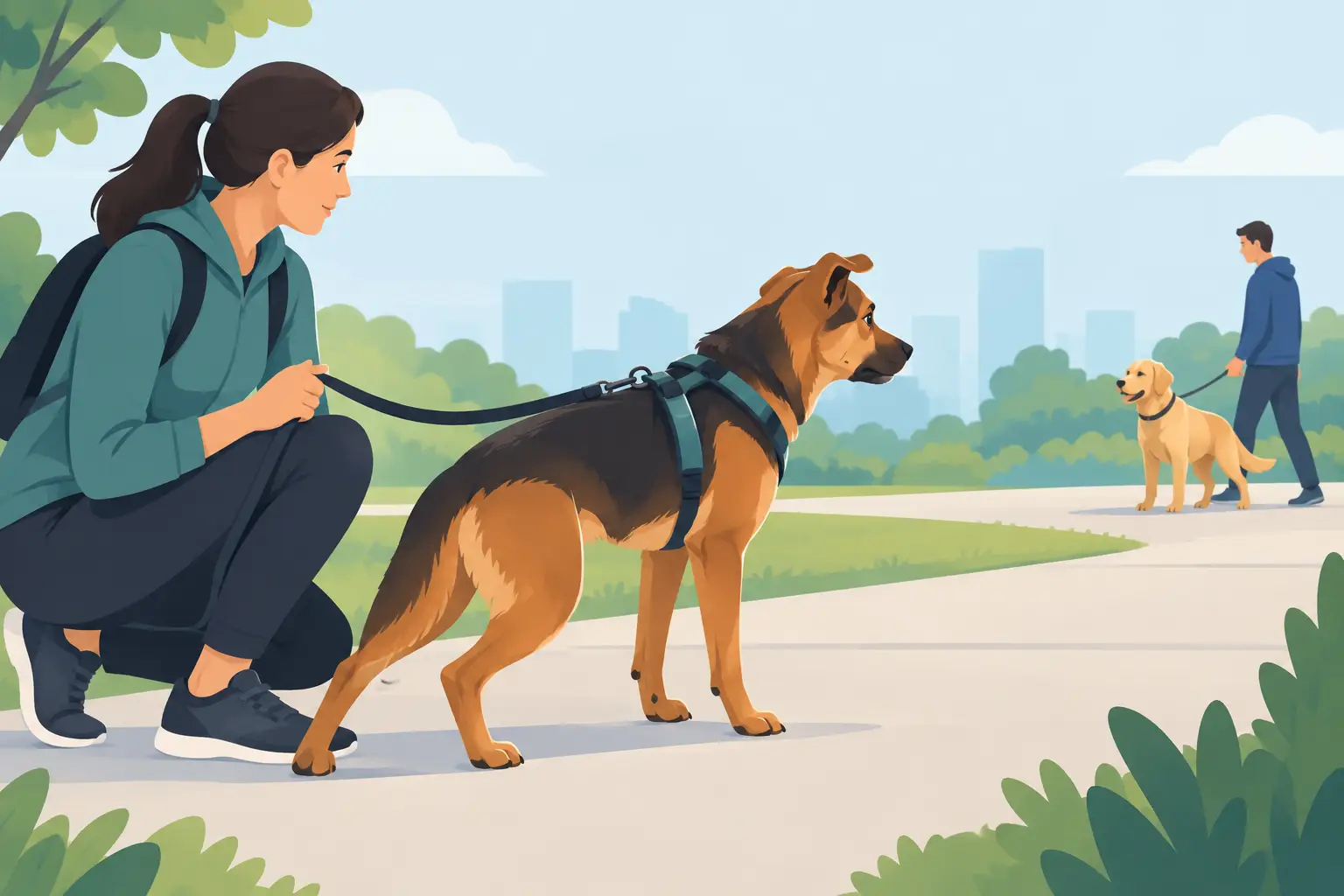
When your dog spots a trigger, distance is often the most effective support you can offer. Cross the road early, step into a driveway, turn down a side street or calmly walk the other way. This is not giving in. It teaches your dog that you listen when they say a situation is uncomfortable.
If your dog notices another dog and can still take food, look back to you or move on, mark that calm moment with praise and a reward. You might say a quiet “good” and feed several treats while the other dog passes at a comfortable distance. Over time, the appearance of a trigger can begin to predict good things rather than panic.
Avoid asking for a sit directly in front of something your dog finds frightening. Although sitting can look controlled, it may leave them feeling trapped and unable to create space. Movement is often more helpful. A smooth turn away, a gentle scatter of treats in the grass, or stepping behind a parked car can reduce pressure without confrontation.
There will be times when another dog appears suddenly and there is nowhere to go. Keep your lead as loose as safety allows, use your rehearsed U-turn or scatter treats, and move away without scolding. A reaction is information, not failure. Your dog has told you that the situation was too difficult at that distance on that day.
Keep walks manageable, not exhausting
It is tempting to believe that a reactive dog needs longer walks to burn off energy. Some do need regular physical activity, but more exposure is not always better. A long, crowded walk filled with triggers can leave a dog increasingly stressed, even if they return home physically tired.
A shorter sniff-led walk in a quiet place may be far more beneficial. Sniffing gives dogs information, choice and time to decompress. Let your dog investigate where it is safe to do so, rather than rushing them from one destination to the next. Food searches, gentle training games, chewing, scent work and calm enrichment at home can also meet important needs on days when the outside world feels too demanding.
Balance is key. Complete avoidance forever may make everyday life smaller, but repeated close exposure can strengthen fear and frustration. Gradual, carefully managed practice at a distance your dog can cope with is usually the more compassionate route.
Be thoughtful when other people offer advice
Owners of reactive dogs often receive well-meant suggestions: let them “get used to it”, make them sit beside other dogs, correct the barking, or force a greeting. These approaches may appear to stop behaviour in the moment, but they do not necessarily change how the dog feels. Punishment can also make a scary sight predict an unpleasant experience, increasing anxiety and reducing trust.
Force-free, reward-based handling takes patience because it works with the dog in front of you. It asks what the behaviour is communicating and changes the situation where possible. That does not mean allowing unsafe behaviour or ignoring practical boundaries. It means teaching skills without adding fear, pain or intimidation.
If your dog's behaviour has changed suddenly, or reactivity is escalating, speak to your vet. Pain, skin irritation, digestive discomfort, reduced vision and other health concerns can affect behaviour. For ongoing support, choose a suitably qualified, force-free behaviour professional who will take a full history and consider your household, routine and dog as an individual.
Preparing a reactive dog for a professional walk
Finding care for a reactive, anxious or fearful dog can feel daunting. A responsible walker should not promise to “fix” your dog on a group walk, or assume every dog will suit the same routine. Your dog deserves care that starts with information, observation and realistic planning.
Share as much as you can during the intake process: known triggers, early warning signs, handling preferences, equipment, favourite rewards, medical needs, routes to avoid and what helps your dog recover after a difficult moment. Explain whether they are comfortable around people at the door, how they travel and whether they can be safely walked near other dogs. Honest detail allows a walker to make safer choices from day one.
At Hilltop Hounds, behaviour-led care is built around individual dog information, clear client agreements and emergency veterinary authorisation, alongside dependable communication. As a Level 4 qualified and PPGBI-accredited canine behaviourist, James takes a force-free approach that respects each dog's limits. Being fully insured and DBS checked matters too, but so does taking the time to understand what helps a dog feel safe.
A careful introduction may involve meeting in a low-pressure setting, allowing your dog to observe from a distance, and building familiarity gradually. Some dogs need solo walks, quieter times or routes with plenty of escape options. Others may eventually enjoy carefully selected company. It depends on the dog, not on what is most convenient.
Give yourself permission to make the kind choice
Preparing for a walk does not mean controlling every variable perfectly. Dogs, people and streets are unpredictable. The goal is to have enough planning, equipment and practise in place that you can respond kindly when plans change.
Celebrate the small wins: your dog noticing a trigger and choosing to sniff, taking a treat after seeing another dog, recovering more quickly, or trusting you enough to turn away. These moments may not look dramatic to anyone else, but they are the foundations of safer, more confident walks. Your dog does not need to greet every dog or cope with every busy place to have a good life. They need to feel heard, protected and understood.

